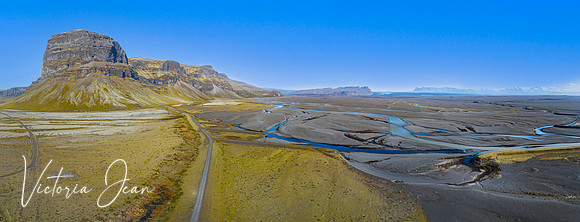
Lómagnúpur Mountain and Braided River Plains in Southern Iceland
Lómagnúpur is one of those Icelandic mountains that is hard to miss—and even harder to forget. It rises dramatically from the flat black sands of Skeiðarársandur in southeastern Iceland, along Route 1 between Kirkjubæjarklaustur and Skaftafell.
What makes it especially fascinating is that it isn't just a dramatic mountain, it has geological and literary history woven into it.
Lómagnúpur reaches 2,507 feet (764 meters) at its highest point. Its enormous exposed cliffs were largely formed by volcanic activity beneath glaciers during the Ice Age. The mountain contains layers of palagonite, lava, pillow lava and volcanic sediments, creating the dramatic banded appearance you see in its cliffs.
The front cliffs rise high above their surroundings, making them among the most imposing cliff faces in Iceland. The mountain was also once a coastal headland, before the landscape and sea level changed after the last Ice Age.
And you can see evidence that this is a landscape that is still changing. A huge landslide occurred on the mountain in 1789, leaving a conspicuous scar on its western side.
Lómagnúpur appears in the famous medieval Njáls saga, one of Iceland's great Icelandic sagas. In the story, Flosi Þórðarson has a prophetic dream while near the mountain.
In the dream, the mountain opens, and a terrifying giant emerges carrying an iron staff. The giant calls out the names of 25 men involved in the burning of Njáll's farm. Those named in the prophecy later die.
The figure became known as Járngrímur, the giant of Lómagnúpur.
And here's the really wonderful connection: the giant of Lómagnúpur is depicted on Iceland's coat of arms as one of the four landvættir, the guardian spirits of Iceland. He represents and protects the south coast.
So when you're standing beneath that enormous dark cliff, you're not simply looking at a mountain. You're looking at a landmark that has been part of Icelandic storytelling and cultural identity for centuries.