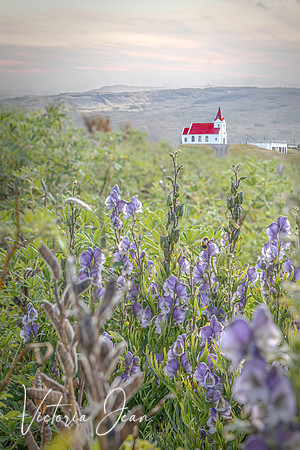
Ingjaldshólskirkja Church with Lupines on the Snæfellsnes Peninsula
The last of the lupines... Can you spot the little bee? Ingjaldshóll Church, or Ingjaldshólskirkja, is one of the most historically fascinating little churches on the Snæfellsnes Peninsula. It sits on a hill between Hellissandur and Rif, with views toward the surrounding landscape and Snæfellsjökull.
There has been a church at Ingjaldshóll since before 1200, and records mention a church there in the early 13th century. A substantial church was built in 1317, when the area was an important center of population and seasonal fishing.
In fact, Ingjaldshóll was once home to what was considered the third-largest church in Iceland, after the cathedrals at Skálholt and Hólar. During the fishing seasons, large numbers of people came to the area, explaining why such a seemingly remote location once needed such a large church. Historical accounts suggest the church could accommodate around 400 people.
The present Ingjaldshólskirkja was built in 1903 and is a protected historic building. It is widely described in Icelandic sources as the oldest concrete church in Iceland, with some sources calling it the oldest concrete church in the world.
It was designed by builder Jón Sveinsson, and in 1914 the tower was raised and other significant alterations were made under architect Rögnvaldur Ólafsson.
Inside are some wonderful pieces of history, including two church bells dating to 1735 and 1743 and older altar paintings. The current altarpiece is a 1903 reproduction of a work in Reykjavík Cathedral.
This is where the story gets particularly intriguing but is strictly told as local lore: There is an Icelandic legend that Christopher Columbus spent the winter of 1477 at Ingjaldshóll, supposedly coming to Iceland to learn about the voyages of Norse explorers to North America. The story says he came through the nearby harbor at Rif.