Archive
January
February
March
April
May
June
July
August
September
October
November
December
|
|
|
|
|
January
February
March
April
May
June
July
August
September
October
November
December
|
January
February
March
April
May
June
July
August
September
October
November
December
|
|
January
(1)
February (1)
March
April
May
June
July
August
September
October
November
December
|
January
February
March
April
May
June
July
August
September
October
November
December
|
January
February
March
April
May
June
July
August
September
October
November
December
|
January
February
March
April
May
June
July
August
September
October
November
December
|
|
|
January
February
March
April
May
June
July
August
September
October
November
December
|
January
February
March
April
May
June
July
August
September
October
November
December
|
|
 Frame of Mind Frame of Mind
I appreciate shares as it helps grow my business. Enjoy!
_________________________
Featured Posts
2023 In Review
 2023 In Review 2023 In Review
2018 Coast to Coast RV Roadtrip
 2018 Coast to Coast RV Roadtrip 2018 Coast to Coast RV Roadtrip
_________________________
Recent Posts
We spent a night at a little gem very close to home, camping at Mike Roess Gold Head Branch State Park in Keystone, FL. It was a refreshing little getaway, and depicts what REAL Florida looks like! No, we're not all sandy beaches and palm trees.
This little park has rolling hills, tall pines, boardwalks down inside spring fed crevices, and winding hiking trails along wetlands thriving with wildlife. We went out to watch the Sun rise over one of their small lakes and it was quite something. The air was soft and relaxing with a thin veil of fog lifting in the distance. Morning sounds of frogs and songbirds floated through the plains, and to gaze out over the water made me feel like I was in a Monet painting surrounded by lily pads. It was sublime, recharging in fact.
After the Sun rose, on our way back to camp, I noticed some deer off in the distance in the water and made sure to stop to capture it with my 600mm lens. It wasn't until looking through the lens that I realized just how special this place was. I couldn't believe all the wildlife I was seeing! In this one image, there are AT LEAST 15 different animals between the deer, the water foul and who knows what else. Can you see them all? I'll make it easier and circle the ones I was able to see, just scroll to the bottom of this post for that photo. I can only imagine what else was out there that I wasn't seeing. This place is like a mini Paynes Prairie, just amazing!
I could almost hear the deer slurping as they dunked their head to pluck off lily pads and munch them down. They must have been pretty tasty for them to brave the possibility of a gator preying on them. Just when I thought I'd seen them all, another head popped up in the distant brush. They were all waking up to go graze for breakfast.
Take a look!
 Mike Roess Goldhead Branch State Park Mike Roess Goldhead Branch State Park
 Mike Roess Goldhead Branch State Park Sunrise Mike Roess Goldhead Branch State Park Sunrise
 Mike Roess State Park animals Mike Roess State Park animals
It's been a bit since I got out to shoot a launch. I've been busy studying for my next adventure to come in the Spring, but more on that later. We were fortunate to have two night starlink launches in a row. Of course, I skipped the first, being Thursday night (I was actually simply too tired to get out in time). I did manage to make it out to the dock for last nights launch though. Being a full Moon rising directly over the launch area, I wasn't sure how well I'd be able to expose the launch itself. It takes anywhere from five to eight minutes of leaving my shutter open to catch the arc, and with the brightness of a full Moon directly overhead, I was not expecting a great result. I guess you can be the judge.
The first image was nearly eight minutes. It was so bright, it washed out the booster return. You can see an elongated Moon due to it moving during that timeframe.
The second image was the moonrise as I arrived on the dock, a beautiful orange and low enough yet to make a lovely scene.
Click on the image to see a larger version, or to explore more in my galleries.
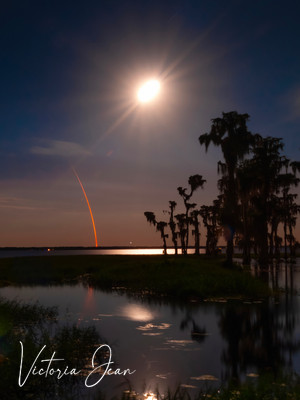 Moonlit LaunchStarlink satellites launch into space at 10:45 pm on Thursday, May 23, 2024. Seen here during a full Moon over Santa Fe Lake, FL. Moonlit LaunchStarlink satellites launch into space at 10:45 pm on Thursday, May 23, 2024. Seen here during a full Moon over Santa Fe Lake, FL.
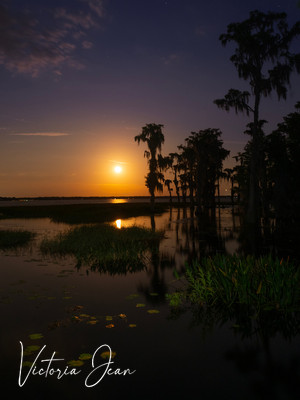 Full Moon RisingThe May full Moon rises over Lake Santa Fe in Florida. Full Moon RisingThe May full Moon rises over Lake Santa Fe in Florida.
How about another sweet sunset? These sunsets on the local lakes just get me, especially with the cypress trees and Spanish moss. But there were (very literally) hundreds of mosquitos that swarmed inside my truck while I had the door open, getting my gear ready. I normally wear a clip-on butane operated repellant, but this time, I had to leave it running clipped to my seatbelt inside the truck with the windows cracked to chase all those damn things out. It worked, and only took 15 minutes. Ridiculous. But the sunset was worth it.
Click on the photo to see a larger version, and to see more in my sunrise/sunset gallery.
 Southern Summer Dock Southern Summer Dock
I've been waiting for this shot for a while... The International Space Station with Crew 8 on its orbital path brought it across the crescent Moon on Saturday night. I've been watching its path projections for a few weeks to make sure I would have the location right, so when Saturday night arrived, I drove out to the coordinates in Alachua and set up my little telescope as well as my Fuji with the 600mm (900mm effective) lens on and began waiting. I knew I had to be on my toes because the projection can sometimes be off by a few seconds, and that's all it would take to miss this shot since it lasts only a few seconds itself. I had my countdown timer app going just to make sure. As 9:22 closed in, I hit record video on the scope and glued my eyes to my camera viewfinder.... would I catch it? I wasn't sure. I had missed my last attempt. Then all of a sudden my eye caught a glimpse of what looked tiny bug in my viewfinder and I knew instantly... NOW NOW! I told myself, as I pressed in and held the trigger of my shutter release and at the same time, breathed a sigh of relief as I watched it fly across the crescent Moon off and out of the frame on its continued journey around the Earth, all in a matter of two seconds.
YESSSS!! I danced a little in glee (I was by myself, nobody to see) and softly exclaimed into the dark night, "I got it! I GOT IT!", then quickly texted my husband and Mom because I was so excited.
This was special to me because on March 4, 2024, I also captured the ISS Crew 8 as they launched into orbit toward the Space Station (see that image by clicking HERE and HERE.
), relieving Crew 7 from their duties. They continue to conduct experiments and gather data on their 6-month stay. Hopefully, I will yet capture their Solar transit as they cross the Sun, and their splashdown as they return to Earth sometime in September of this year.
EDIT: On May 30, I captured a streak shot as they passed over The Cove HERE.
Below, the first image is from my Fuji camera with a shutter speed of 1/1000, and the second is a video from the telescope slowed to half speed for better viewing.
 ISS Lunar Transit
 VIDEO ISS Lunar Transit
ISS Lunar Transit VIDEO
Yes, I did attempt to chase down the Northern Lights during the recent G5 storm, but I was a day too late I'm afraid. Don't despair because that gives me a reason to travel to one of the epic locations where they are dramatic and far more visible.
Instead, I went out on Saturday night, for some dark sky photography. It started with attempting to capture the International Space Station as it transited a crescent moon at approximately 9:22 pm. If you want to see how that went for me, check back for more on that in a later post.
I also captured a few deep sky clusters and galaxies... more on those later as well...
Then, I drove an hour and a half up to Southern Georgia to a dark sky site in an attempt to get the Milky Way rising in the early morning hours of Sunday. I wanted to have it rising over the Suwannee River, with a reflection on the water. I found the perfect spot for that, on the banks of the Suwannee near the Stephen C Foster State Park. This photo was captured around 1:30 am over the calm and quiet Suwannee River. Surprisingly enough, there were no mosquitos or bugs to contend with! Though, I heard plenty of coyotes howling and yipping in the nearby forest. I would hear a ripple on the water every now and then and the hair on the back of my neck would rise, fearing an alligator was creeping up on me. I'd swing my flashlight in that direction as if it were a light saber cutting through the thick darkness toward whatever menacing threat was crawling out of the water toward me, only to discover the blips of water splashing was from small fish along the waters edge plucking off a bug from the surface every now and then. I think it was safe to say I felt a bit uneasy under the cloak of darkness.
While this is not the best shot, I feel safe telling you all that I'm learning better ways to photograph and process Milky Way images (currently in class to learn this). One thing I do know, practice makes... well, I won't say perfect, but it sure can make my imagery better. So, I'm putting this one out there to depict a starting point. I may come back and re-edit it (reduce the purples?) after I learn better editing techniques. It all just takes so much time, something I wish I had more of.
Your feedback is welcome, constructive criticism can only help me grow.
Click on the image for a larger version and to see more in my Astrophotography gallery.
 Magic Suwannee RiverThe Milky Way galactic core rises over the Suwannee River early May. Magic Suwannee RiverThe Milky Way galactic core rises over the Suwannee River early May.
Here's a throwback. I loved the symmetry in this single photo, seemingly too painterly to be real, but that is exactly what drew me to stop to photograph it. This is a scene from a California vineyard taken many years ago on one of our roadtrips. I can still so vividly recall this field. I was totally taken with the colorful contrast and satisfyingly perfect rows of lushious greenery starting to mature in the warm California sun. Not a single weed in these rows, creating such perfect separation it almost felt unnatural. And that sky, such a perfect sky. The hills gracefully rolled along the roadside of our drive. It was the first time I had seen vineyards of California. I wanted so badly to pull over and park in the crunchy gravel and sit at the top of one of those hills with my husband; barely shaded but letting the sun tenderly burn my cheeks as we enjoyed artisen cheeses and sipped a delicious red wine. Sigh, but that was just my imagination. We had no fresh cheeses in the vehicle and certainly no good wine. And I think we may have been arrested had we frollicked up into those fields. I'll sit with my imagined version of events instead.
Click on the image to enjoy a larger version, or to see more in the Scenic gallery.
 California California
I promised you the story, so here it is. If you are not a reader, I suggest scrolling to the bottom where you will find the photography. I need to write this out mostly for myself, so I don't forget the epic adventure my mom and I had.
First, a few fun facts about the Sun, Moon and eclipse!
- The solar eclipse can only occur at the new moon phase, when the dark side of the moon faces us
- The sun is 400 times the diameter of the moon, but at the point of eclipse it is 400 times farther away, making them appear the same size
- The solar prominence (red flares) can reach up to 93,000 miles high and can last days to weeks and contribute to our Northern Lights
- The planets Venus and Jupiter, as well as Pons-Brooks comet can be visible during totality of 2024 eclipse
- The eclipse creates a 360 degree sunset effect in the path of totality
- Temperatures drop dramatically during totality
- Einstein's theory of relativity was proven during a 1919 solar eclipse
- Eventually, Earth will not have total solar eclipses as the Moon moves away from Earth approximately an inch each year, causing only annular eclipses to be visible when that time arrives
And now, the rest of the story...
After getting more exposed to the world of astrophotography, I shot my first eclipse last year, an annular eclipse, but it was really motivating for me. I wanted more. I knew a total eclipse was in the works for this year and I was determined to make it mine. I began studying and planning, learning about all the special techniques and filters and processes I would need to capture the imagery I wanted. I followed this course for the next seven months, digging into books, videos, anything I could consume to learn more about the photography aspect.
Since the path of totality would not cross where I lived, I eventually determined Texas for my destination for viewing (Austin to be exact) because it would have the best probability for clear skies in April. You see, if you're not in the path, your experience just cannot measure up, and in hindsight now, I cannot stress that enough! I wanted the full experience right within the path.
I then spent the next thirty days pinpointing a good location along the path of totality, before attempting to book (six months out at this point). Thats when I first learned how important this was, how many people were on the same journey as I. You know what that does to the law of supply and demand... price gouging had already begun, and I was not willing to pay upwards of $700 per night for a hotel. I found a reasonable Air B&B right in the path, a close enough drive to the centerline. After hearing other stories of how hosts cancel reservations last minute (likely because they got another guest willing to pay more), leaving the guests scrambling to find alternate accommodations, I booked at two different places to have one of them as a backup. Yes, I felt guilty, but you know what? I was investing so much in this, doing so much research and planning, I did not want to get screwed out of a place to stay.
Having my lodging taken care of, I then booked my flights only to find that at six months away, everyone else had already started doing so, leaving no available rental cars to accompany my flight plans. My recourse was with an app and system I was unfamiliar with, Turo. That one made me nervous, renting a car from a total stranger, hoping it all pans out for me and I don't somehow end up damaging the car. I booked it anyhow. Flight, car and accommodations are all set!
For the next two months I continued studying and examining the general Texas landscape for the best opportunities. I learned all state parks were closing access for eclipse day unless you bought a special day pass, so I found three parks that could work, and I got my day passes. When I checked for availability a week later, they were all sold out. I was very happy to have settled on some good locations, and if mother nature was in my favor, the blue bonnets would be in full bloom there!
So I continued studying and practicing my day-of routine, using a special app as a timer so I would know when it would be safe to remove the solar filter from my lens, and when all the various events of the eclipse would occur, practicing quickly changing my camera settings to account for the rapid change in light through those phases that would pass in a matter of seconds. I think the more I practiced, the more nervous I got.
At the three-month point, the first Air B&B cancelled on me, just as I feared, claiming booking errors. I was glad I booked the fall back because a quick search revealed sparse availability with insanely high prices. I reached out to the host to have her reassure me she would not cancel, and everything was set in stone.
The months fell to weeks as eclipse day approached and my dreams began to be consumed by eclipse photography.
I was hawking weather apps and charts, following the ever-failing forecast for Texas. Heavy clouds were now expected for almost the entire path of totality from Texas up to Ohio and my heart started sinking. Had all my preparations been for nothing? Had I wasted my money? Would I ever get another chance?
The weeks fell to days and now it was quite evident my sweet spot in Texas had soured, along with my excitement. Mother nature left me scrambling to make alternate plans somewhere else if I wanted any hope of seeing, much less photographing the eclipse. The forecast was showing fairly clear skies for parts of Arkansas and Illinois, and even New York. But how on earth was I going to find accommodations?
I had friends in Illinois offering up a place to stay near the path and their forecast was pretty damn good. The 11-hour drive one way was very tempting. I kept that on my radar.
My sister up in New York also had good weather anticipated and was within a few hours of totality. She mentioned wanting to take her family to view, so there is another possibility. Another very quick search for airfare showed the cost of tickets at that point was $2000.
Or do I chance it that Texas would ultimately clear just in time? I could possibly drive a bit in Texas if I had to, but I had that weird rental with mileage limitations.
All these things were swirling around in my head now with my eclipse techniques and weather watching. I found myself checking weather apps hourly in the preceding days before finally (with much support and encouragement from some wonderful people) I pulled the trigger on New York.
What better way to do this than with family? It should make for some good memories! I quickly cancelled all of my Texas reservations and watched as many more began doing the same for that area. The severe storms forecasted even had event hosts cancelling their viewing events. Perhaps I made the right choice after all. Time will tell.
I landed in Albany, New York and it seemed those pesky clouds followed me up there. Again, I was filled with dread as the forecast worsened the day before the eclipse. We made plans to take two cars; one for my sis and her family for their viewing and one for my mom and I for our viewing. Mine would take many hours longer and we didn't think the kiddos could make that long of a commitment.
I was trying like hell to find good spots to set up all my gear and shoot from. A place where my sister's car would not get towed and somewhere that had restrooms close by. A place with a clear open view of the sky and interesting foreground. This was not as easy as you'd think. I used google earth and google maps quite heavily that day. My sister’s husband even picked up an Atlas for me to use because it was highly likely the network would be overwhelmed and my navigation wouldn't work.
That night was a restless one with little sleep. I was so excited. I kept replaying the different sets of images I wanted over and over in my mind. The next morning, my mom and I were up at the crack of dawn. We packed the car with my equipment, a few lawn chairs, and a bunch of snacks for the road and we left at 6:30 am. The general direction was northern Vermont. Traffic and cloud cover would ultimately determine where we ended up.
The roads were surprisingly clear, despite what local radio stations were warning of. They did mention a few times that the city we wanted on Lake Champlain was becoming inundated with visitors, so I quickly scratched that one off my list and we kept going north, around Burlington. The next town on the map was St Albans in Vermont. I had not considered that one at all, but it was at a point where I could quickly turn and go east to further outrun the clouds. We got there around 11:30 and the sky looked great, so we drove in and found a PERFECT spot at a tiny park on the lake. I think we were probably the last of a few cars they allowed in before closing the parking area.
We dragged out all our gear and plunked down on the lawn with hundreds of other viewers. The crowd slowly grew, music was playing, everyone was buzzing around, setting up cameras, telescopes, and cell phones to capture the magic. It felt like a fair. I attempted to recalculate my timing app for our specific geographic location, to also account for the few seconds of difference in lunar limb contacts (important to catch the images I had in mind) but there was no signal available for my phone. So, I resorted to calling my tecch support, my husband back home. I briefly explained what I needed and sent him to the website to look up calculations based on where he could see us on the map, and with success, he was able to provide me with the updates I needed. I finally had all my gear ready and tested a few shots. Now we wait. Mom was all comfy, crocheting while she waited. I was pacing. I did manage to put my drone up in an unoccupied area, I wanted to capture something showing the crowds and the lake area. I knew I wouldn't be able to fly during totality (unless I cloned myself) so these drone images would have to suffice. We tried some of the food from a food truck vendor and waited some more. I impatiently watched a far off front of high clouds begin to approach. I knew they would ultimately arrive with the start of the eclipse, I could only hope they would stay thin enough as to not impair my plans.
First contact was mere minutes away! I was giving Mom the countdown. And then it was time. Like a gentle tap on the door, the moon cautiously presented itself.
"IT STARTED! IT STARTED!" I was exclaiming to her, so she could put her glasses on and watch. Granted, the start of the partial phases is not too exciting unless you've never seen it before (or you're a bit of a geek like me). The tiniest curve of the Moon began to merge into the Sun. It proceeded ever so slowly, almost as if it were shy from all the viewers watching its performance. Yes, it is a very slow progression, and Mom went back to crocheting, looking up on occasion to see how far it had passed. Meanwhile, I was snapping away with my camera, catching all the partial phases for my composites later. Soft thin clouds floated through every now and then, darkening my exposure and dulling a crisp focus, but I carried on. When the Sun was close to a sliver, I was bubbling with excitement. My hands started to shake as darkness began to roll over us, now is when I need to make all my fast adjustments within a matter of seconds for the totality phases.
My brain didn't fail me, and it felt seamless. The bright white light of the sun withered to a hairline curve and eventually disappeared, I immediately took the filter off to let the Diamond Ring and Bailey's Beads present themselves. "Mom, look without your glasses! It’s amazing!" I couldn't believe what I was seeing through the 600mm lens on my camera. Heckin amazing! My mouth was hanging open in awe the whole time. And the crowd agreed, they let forth cheers and screams and applause, music began to play again with all the excitement. I kept snapping away like crazy. I did pause for a moment in the middle of totality to soak it all in. That black dot in the sky felt otherworldly. It was so bizarre and moving. How insignificant I felt at that moment for some reason. The darkness above revealed the bright planets that could normally only be seen at night. A faint glow of yellow and orange was on the horizon. It felt so sublime. Birds had come into land and nest with the darkness falling. Then the faint peeks of light began to creep out from the other side of the Moon as it continued on its journey. I was quickly manipulating my camera for this second set of quickly passing phases. I was shaking so much, I didn't know if I'd slip up and miss the shot. I was glad I had a remote trigger to press for shutter release. The temperature dropped so fast, it was very cold, probably in the low 50s. The warmth from the sun faded as quickly as its light. I was relieved when the light began to reappear on the other edge of the moon. Then just like that, the darkness dissolved and daylight returned, along with quite the clamoring from birds. They were making more noise than the crowd, squawking and chirping. The sky was full of gulls flying to and fro. I would have like to known what they were thinking. It was chaos in the sky.
I breathed a sigh of relief and jumped up and down like a kid, squealing to Mom, "I GOT IT, I GOT IT!!", knowing that my one goal for imagery had been captured; Baileys Beads. But I got so much more than that. The sun (moon?) dog that appeared around the sun like a halo during partial phases. The Diamond Ring phases when the light returns, creating a phenomenon that looks like a solitaire diamond engagement ring. Bailey's Beads where the light is totally obscured by the Moon except for where it filters through the craters, causing a string of beads to appear. Solar prominences (which was a complete surprise for me) where the flames of the sun shoot out far enough to be seen from around the Moon. These coronal mass ejections can reach 500,000 miles long, and we were lucky enough to have them occurring during totality. The full corona of the Sun which is the gas-filled outer most edges of the Sun's atmosphere. Some wide angle shots with my back up camera, and a little bit of pre-eclipse aerial imagery with the drone. So much! I was beside myself.
We stayed and continued out the remainder of the partial phases while most others left the park after the main event. At least we wouldn't have to battle that mess of congestion... but wait...
After it ended, I packed up, we started on our journey back. We did see some lovely scenery as we skirted along the Canadian border heading back to the highway. That's when we hit the rest of the masses that had traveled up from NY City and every other place known to God to sit on what seemed like the only road going through Vermont. The highway was literally a parking lot. Barely getting over 20 mph the whole way back, we crawled along into darkness with the river of car lights. What took 2.5 hours getting up took 6 hours getting back. We were exhausted and giddy all at the same time, reflecting back on the whole day's events and it was marvelous.
My takeaway in the end?
IT WAS ALL WORTH IT.
But in all seriousness, this was a learning experience, just like the last eclipse, and I'm getting better each time. This time I was prepared with a solid sturdy tripod and a better filter, and used a few more techniques to allow stability and manual tracking. Next time, I will want to try using an auto-tracker for more freedom, and perhaps a more exposed diamond ring and Bailey's Beads phase. I'd like to have a better plan for wide angle timelapse, I don't think I properly exposed for that on this run. I'd also like to have a specific plan for exactly what times I will take partials, so that I have perfectly timed partials without having to cull through hundreds to find matching phases on either end. And of course, a clear sky would be nice. I'm actually eager to give this another try, but that will mean travel to another country for the next eclipse. I guess that would make me an official chaser!
There's so much beauty out there if you only take the time to look and seek adventure. Stuff your eyes with wonder, and remember, "Ones destination is never a place, but a new way of seeing things." ~ Henry Miller
I want to give a big shout out of gratitude to my husband for allowing me to follow my dreams and adventures, to my boss for his extreme generosity and encouragement, to my sister and her family for being so gracious with me for the last minute planned trip, to my mom for being my adventure sidekick for many of these events. You are all so very much appreciated, I can't express enough how much it all means to me.
Now, for those of you that scrolled all the way to the bottom without reading my story, here is what you came for...
Click on any photo to see a larger version and to see more in the Astrophotography gallery.
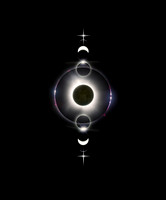 Alignment Alignment
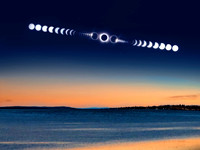
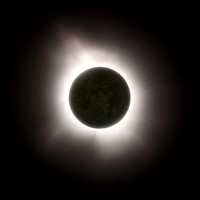

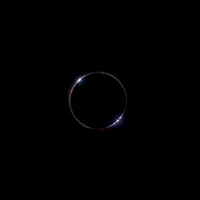
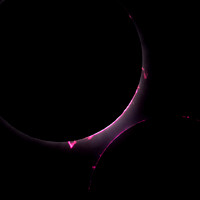
 Solar Luna Chaos Solar Luna Chaos
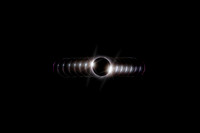

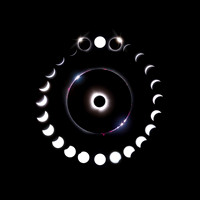
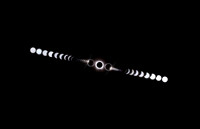
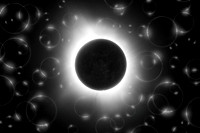
Oh. My. Gawd. That eclipse was AMAZING. I can't really put into words how magical this experience was!! I now have over 700 images to cull through, but I have to go to work today. I squeezed out a couple very quick and rough edits just to show my captures. My biggest goal was Baileys Beads, AND I GOT IT! ...and then some! There is a whole story about my adventure coming shortly, with all the imagery, but for now, these two lonely images will have to do. I was using a new solar filter, one without orange hues to it.
May I present, Bailey's Beads and the Diamond RIngs! Click on the photo to see a larger version.
Stay tuned for more...
Update: You can now find the full story with all images here: My Epic Eclipse Adventure
Baileys Beads 2024 Total Solar EclipseThis is a phenomenon that occurs as the Moon almost entirely covers the Sun, only allowing the sun to shine through the very edge of the craters of the Moon. Light is entirely blocked except for what spills through those craters on the edge, creating a prismatic string of beads effect.
Diamonds 2024 Total Solar EclipseThis phenomenon occurs when the Moon passes just far enough beyond the Sun to allow for light to begin pouring back into view. The very edge of that light reveals itself as a bright prismatic "diamond" set on a less bright ring of the silhouetted Moon. It presents as a solitaire diamond ring, or a pair in this case.
I try not to waste opportunities where I'm able to spend a few hours with my camera in hand. Last week, when I traveled down to Titusville to attempt to photograph the Crew 8 launch the first night (but alas, it was scrubbed), I did spend the day in the area shooting things other than a rocket launch. Some of you local Rocketographers will recognize this spot, I'm sure you know it well! The view across the water is actually the Space Center, but with this high key contrast on the horizon, its impossible to make out the buildings. I just love how the palm trees hang over the shoreline. I need to find more of these.
It was a little overcast at the time of these photos, so the color is not that punchy. But I do really like how they look in a monochrome set. I hope you do too!
Click on the images to see larger versions, or to enjoy more scenic images in the gallery. If you like the set, I hope you know, I do sell my images!!
 Titusville Trees 2 Titusville Trees 2
 Titusville Trees 4 Titusville Trees 4
 Titusville Trees 3 Titusville Trees 3
 Titusville Trees 1 Titusville Trees 1
I finally had time to get to the rest of my images from the Crew 8 launch. I would have loved to stay up all night after I got back to process a few, but I do have a full time job, so that takes me away from this fun stuff. At any rate, here are a few extra images from the launch of Crew 8 on their journey to the International Space Station to relieve Crew 7. They will spend approximately 6 months up there conducting various experiments, some of which will help prepare for future Artemis missions and our planned return to the Moon and eventual trip to Mars!
I do plan to follow these astronauts as they orbit the Earth for 6 months, so stay tuned for more images of their journey aboard the ISS.
Click the image to view a larger version and to see more images in the Rocket gallery.
 Crew 8 on Falcon 9 Crew 8 on Falcon 9
 Crew 8 on Falcon 9 Crew 8 on Falcon 9
 Crew 8 on Falcon 9 Crew 8 on Falcon 9
 Crew 8 on Falcon 9 Crew 8 on Falcon 9
View my previous post with the initial launch photo.
 Crew 8 on Falcon 9 Crew 8 on Falcon 9
Also, a video of the "Nebula" effect as the stage separation occurs.
Crew 8 Nebula Video
What a spectacle! After being postponed a few times due to inclement weather, and even a last-minute discovery of a crack in the seal of the crew's capsule hatch threatening the launch again, it finally lit up the sky in a glorious fashion! The crowds did indeed gather to view this one, and all roared to excitement as the rocket ignited and lifted off from Kennedy Space Center with Crew 8 on board heading to the International Space Station. The excitement was as thick as the humid Florida air on a stormy summer night. I myself made the 5-hour round trip drive two nights in a row to witness this launch, so I was very happy when it successfull launched.
NASA Dragon Crew-8 on SpaceX Falcon 9 rocket. The capsule will travel to the ISS where it is expected to autonomously dock with the station at around 3:00 am EST early Tuesday morning. There, the Crew will relieve Crew-7, and will stay aboard for 6 months, conducting various science experiments while they orbit the earth some 250 miles above us. Keep an eye out for more photos of this Crew and their paths as they become visible to me during their time in orbit, I will be sure to share every encounter I can capture!
Click on the photo to see a larger image, and to see more rocket images!
 Crew 8 on Falcon 9Crew 8 launches to the International Space Station on March 4, 2024 on a Falcon 9 rocket from Kennedy Space Center where they will spend the next 6 months conducting experiments and collecting data while orbiting Earth at over 17,000 mph! Crew 8 on Falcon 9Crew 8 launches to the International Space Station on March 4, 2024 on a Falcon 9 rocket from Kennedy Space Center where they will spend the next 6 months conducting experiments and collecting data while orbiting Earth at over 17,000 mph!
SpaceX Crew-8 is the eighth crewed operational NASA Commercial Crew flight and the 13th overall crewed orbital flight of a Crew Dragon spacecraft. NASA astronauts Commander Matthew Dominick, Pilot Michael Barratt, and Mission Specialist Jeanette Epps, along with Roscosmos cosmonaut Mission Specialist Alexander Grebenkin are riding aboard.
I'm trying a new compilation project, much like the one I did several years ago on the Ocoee River in Tennessee, but with a twist. My goal is to capture all of the beautiful colors of the view over The Pass on Lake Santa Fe, during different seasons, various times of day, whenever the mood strikes me. This is the beginning.
Enjoy from a 200-foot birds-eye view of the pass, all of its various forms (when weather allows me to fly that is).
Click on the photo to enter the gallery and view my progress.
 Project At The Pass Project At The Pass
Oddie made it!! "We can confirm without a doubt the equipment is on the moon," Dr. Tim Crane said on the NASA broadcast. "Odysseus has a new home."
A nail-biting and exciting evening as we listened to hear the fate of Odysseus, after facing some problems that were worked out during a few additional Moon orbits, the lander made a successful landing in the South Pole region of the Moon. This is the first time in over 50 years that a US built spacecraft has landed on the Moon.
Intuitive Machine's lander launched last week on a Falcon 9 from Kennedy Space Center, which also was a milestone for myself as it was the first launch for me to ever photograph the nebula effect during a launch.
Now, as I gaze up at the moon tonight, I wonder what part of the South Pole that little guy is hanging out at, excited about the potential and possibilities
this will bring for further exploration.
Click the photo to open a larger version, do you think you can see anything?
 Feb 22 Historic Moon Lunar Landing Feb 22 Historic Moon Lunar Landing
 Nova C Lunar Lander Nova C Lunar Lander
"...He decided that the sunrise and sunset brought wild, free sadness; the sunset, a lonely yet a comforting one." "He worked at night until the sun had set, and the red and orange faded through the pines, and the split rails merged with the color of the earth."
Excerpts from The Yearling, written in 1938 by Marjorie Kinnan Rawlings; a fitting set of prose for these images, as they were both shot from what I imagine was the very spot where this local author stood to absorb those red and orange rays as they fell over her while watching the sun settle below the edge of the lake.
This coming-of-age story about a boy that adopts a yearling fawn, set in the backwoods of Northern Florida, won a Pulitzer Prize in 1939 and remains a literary treasure. Marjorie used a lot of what she had in her surroundings to influence her stories in The Yearling, Cross Creek and many other wonderful fictional stories. She lived and worked in the small community of Cross Creek, a short ride from my house. Now, it is a State Park where visitors can step back in time when they enter her farmhouse or stroll through her gardens.
The dock where these images were taken is actually part of a boat ramp, which proved VERY challenging in capturing. While the sun only sets at this exact angle and location for a short time, I had to make the most of it. The first attempt failed, as there were far too many boaters constantly in my frame, ruining the peaceful nature I was seeking. On a second visit, the colors were a bit prettier, but the boaters were just as numerous. However, they managed to time their exits off the water infrequently enough to allow me to capture at least one good shot of the sun before it fell too low. In the process, I decided to make the best of it and catch a boater in the reflection of the sun for an alternate style of the image. Either way, I'm satisfied.
Click on the image to see a larger version or to see more sunscapes.
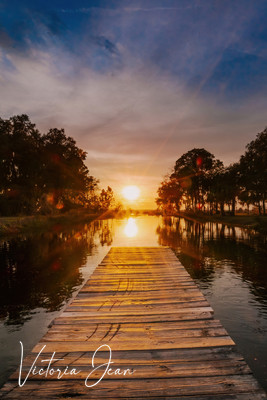 Storybook SunsetSun sets at the edge of Orange Lake near Cross Creek. Storybook SunsetSun sets at the edge of Orange Lake near Cross Creek.
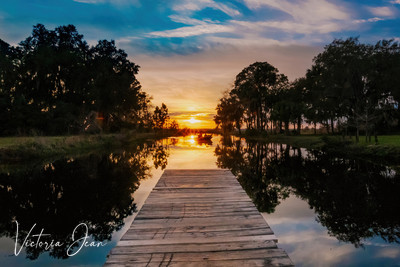 Storybook SunsetSun sets as the fishermen come in off Orange Lake near Cross Creek. Storybook SunsetSun sets as the fishermen come in off Orange Lake near Cross Creek.
Let's continue with my Valentines night of rockets, while not that enamoring to most, it is for me. If you're just joining us, you can read PART 1 HERE. Where did we leave off... Ah yes, I stayed up after getting back home from the USSF-124 launch from 5:30 pm earlier that evening. The Nova C launch was scheduled for around 1:00 am, so I went out around midnight, with the intention of capturing star trails leading up to launch time so I could composite them with the final launch image. Of course, I was a bit nervous for the actual launch to take place, it had been cancelled the night before so I was hoping it would go off without trouble tonight. I wouldn't be able to place my camera in the same position again to make my plan with star trails work if I had to come back.
I had the live feed of narrators playing on my phone, talking about the mission, the payload, the rocket, it all adds to the anticipation and helps me to understand this world of rocketography a little better. (Yes, I made that word up). As the final countdown approached, I quickly switched my camera settings from star trails to what I needed for an 8-minute exposure for the launch itself, a little worried about the cloud cover that had moved in, but I was rolling with it. I also knew with a due East trajectory, I would be able to see more of the stage separation and burn back maneuver, which if I were lucky enough and made the right camera setting selections, I might be able to capture the elusive nebula effect on my second camera that I was hand-holding.
It launched right on time, but did disappear a little under the layer of clouds, but reappeared just in time for stage separation! I was ready. I pointed my 600mm lens at the magical effects unfolding in the sky far above me, and I was wonderstruck with the detail I could see from so far away. It was fleeting, disappearing as quickly as it came, but I knew I caught several nebula images, even at this distance. I did a little happy dance knowing exactly what the final image for this launch would be if I could do my post-processing properly.
And now, after finally finding the time to invest in processing the whole evening, star trails to nebula, this is the final result.
I love rockets!
Click the image to see a larger version, and to see more rocket images. I am currently working on a short time lapse video of all the nebula, so stay tuned for that to appear later.
 Nova C Lunar Lander Nova C Lunar Lander
Below is a time lapse video of 33 images captured of the nebula effect, close crop.
Nebula Time Lapse
|


